Kazakhstan poised to become Eurasia’s higher education hub
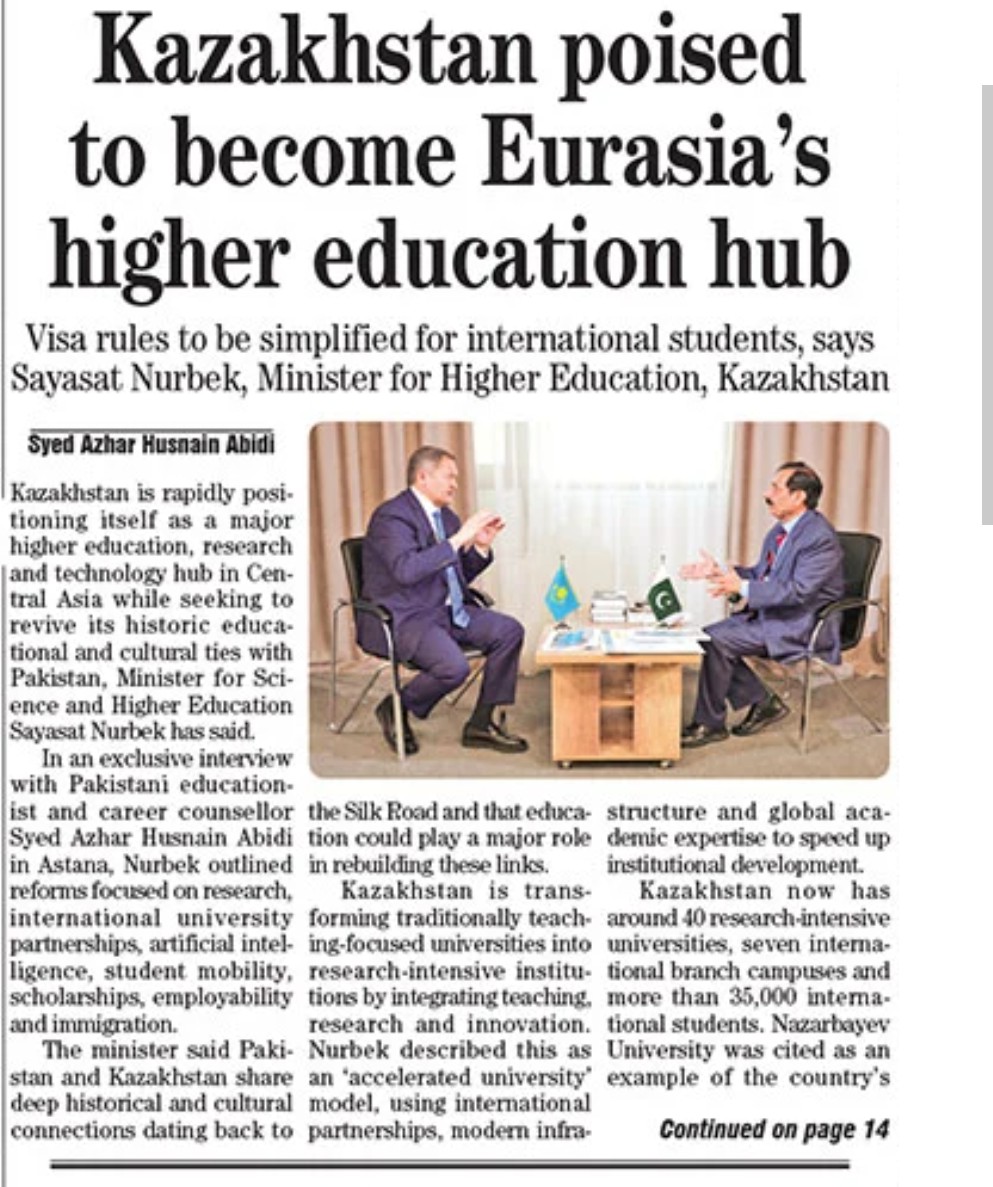
Kazakhstan is rapidly positioning itself as a major higher education, research and technology hub in Central Asia while seeking to revive its historic educational and cultural ties with Pakistan, Minister for Science and Higher Education Sayasat Nurbek has said.
In an exclusive interview with Pakistani educationist and career counsellor Syed Azhar Husnain Abidi in Astana, Nurbek outlined reforms focused on research, international university partnerships, artificial intelligence, student mobility, scholarships, employability and immigration.
The minister said Pakistan and Kazakhstan share deep historical and cultural connections dating back to the Silk Road and that education could play a major role in rebuilding these links.
Kazakhstan is transforming traditionally teaching-focused universities into research-intensive institutions by integrating teaching, research and innovation. Nurbek described this as an ‘accelerated university’ model, using international partnerships, modern infrastructure and global academic expertise to speed up institutional development.
Kazakhstan now has around 40 research-intensive universities, seven international branch campuses and more than 35,000 international students. Nazarbayev University was cited as an example of the country’s rapid progress.
The country is also bringing leading universities from the United States, Britain, Europe and Asia into its higher education system. Institutions, including the University of Arizona, Cardiff University, Coventry University and others are participating in partnerships designed not only to provide international education but also to strengthen local universities through faculty development, research and technology transfer.
Nurbek said Kazakhstan wants research to solve practical economic problems, particularly in agriculture, mining, energy and industrial waste.
Examples include research into converting sulphur waste from oil production into valuable products and extracting selenium from copper-industry waste. Universities and industries are also collaborating through research ‘hackathons’, with successful projects receiving grants.
Researchers can receive royalties from successful patents and commercial applications, creating incentives to turn research into products, businesses and employment.
Kazakhstan is developing a higher education platform where students can access American, British, European and Asian programmes without travelling to the universities’ home countries. Tuition and living costs can also be considerably lower.
For example, Nurbek cited Cardiff University programmes costing around $13,000 in Kazakhstan compared with $20,000–$22,000 in Wales, while De Montfort University programmes could cost approximately $12,000–$13,000 in Kazakhstan compared with around $20,000 in Britain.
For Pakistani students, Kazakhstan offers geographical proximity, a predominantly Muslim environment and opportunities beyond medicine, including engineering, technology, business, research, entrepreneurship and AI.
Describing the country’s welcoming culture, Nurbek said Kazakh people are ‘WARM’—an acronym he uses to reflect the nation’s unique identity: W for Western in outlook, A for Asian in heritage, R for Russian-speaking, and M for Muslims. He said this combination has created an open, multicultural and hospitable society that enables international students, including those from Pakistan, to adapt quickly while experiencing diverse cultural and academic perspectives.
Kazakhstan currently provides 550 government scholarships annually to foreign students and is considering developing a dedicated annual scholarship programme for Pakistani students in cooperation with the two countries’ embassies.
Nurbek acknowledged that visa procedures remain an obstacle for Pakistani students and said Kazakhstan is considering online visa applications, faster processing, study-period visas and mobile biometric facilities in cities such as Karachi and potentially Lahore.
The country also intends to allow international students to work during their studies, with study periods potentially counting towards permanent residency.
A new ‘Studying Kazakhstan’ platform is being developed to allow students to apply directly to universities, similar to the UK’s UCAS system. Students may still use education agents, but agents would no longer be compulsory, increasing transparency in admissions.
Artificial intelligence is another major pillar of Kazakhstan’s reforms. AI education has become compulsory in higher education and is being expanded into schools, with hundreds of thousands of students already receiving training.
The programme progresses from basic AI literacy to deep learning, AI agents, robotics, entrepreneurship and start-ups. Students are also receiving computing resources and seed funding for AI ventures.
Kazakhstan is preparing its first AI-enabled university, where AI could personalise students’ learning, recommend academic activities and assist university management. The university was expected to launch in September.
Kazakhstan is using its Atlas of New Jobs and Skills to identify emerging occupations and redesign university curricula accordingly. Universities have greater flexibility to work with industry, while work-based learning is expanding, particularly in engineering.
Nurbek’s vision is for universities to become centres not only of education but also of research, entrepreneurship, technology transfer, employment and international exposure. Kazakhstan’s location at the crossroads of Central Asia, China, Russia and the wider Eurasian region could also provide students with exposure to regional markets and languages including English, Russian and Chinese.
Nurbek urged Pakistani students to look beyond Kazakhstan’s traditional image as a medical education destination and consider the country for higher education, PhD research, entrepreneurship, employment and international exposure.
He highlighted international university partnerships, scholarships, lower costs, a Muslim cultural environment and Kazakhstan’s expanding research and technology ecosystem.
For Pakistan, Kazakhstan’s transformation could offer a new higher education pathway at a time when students face rising costs, visa restrictions and changing immigration policies in traditional Western destinations.
However, Nurbek and Abidi acknowledged that many reforms remain works in progress and that visa procedures, infrastructure, international awareness and student support will require further development.
The direction, nevertheless, is clear: Kazakhstan is seeking to move from being a country that sends students abroad to becoming a regional hub that brings international universities, researchers, technology and students together. For Pakistan, this could mark the beginning of a significant new chapter in educational and academic cooperation.