Caught in the compliance trap
Interview with Syed Abidi, acclaimed educationist and career counsellor
LAHORE: International education was once largely a competition for the brightest international students. Universities competed across borders on academic reputation, rankings, affordability, scholarships, employability and student experience. Today, another factor is increasingly shaping global student mobility risk.
In an interview with The News, Syed Abidi, an acclaimed educationist and career counsellor, talked about how this shift in international education is affecting Pakistani students and universities abroad.
According to him the UK, United States, Australia and Canada remained major destinations, but their systems had become increasingly focused on immigration compliance, financial credibility, visa outcomes, institutional accountability and student behaviour. Universities and governments are no longer looking only at numbers, but also at who is recruited, from where and with what risk profile.
Discussing the UK, Mr Abidi said the closing months of 2025 were particularly difficult, as high visa refusal rates among Pakistani and Bangladeshi applicants intensified concerns. Moderate-fee universities reliant on international enrolment became increasingly cautious about CAS issuance.
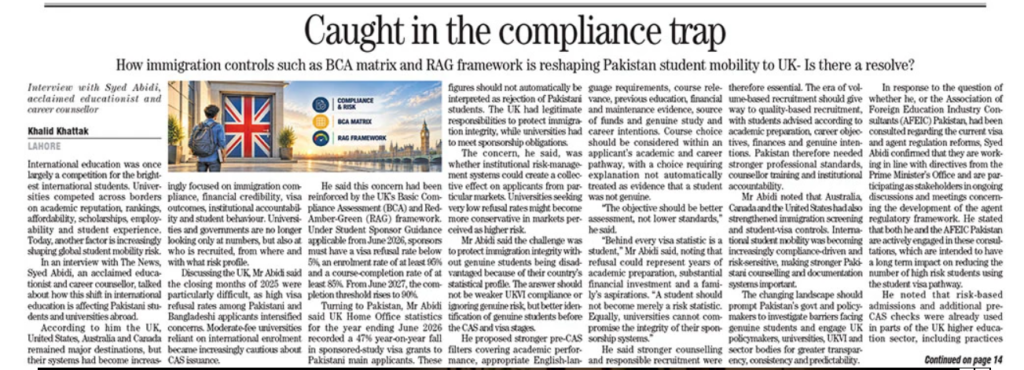
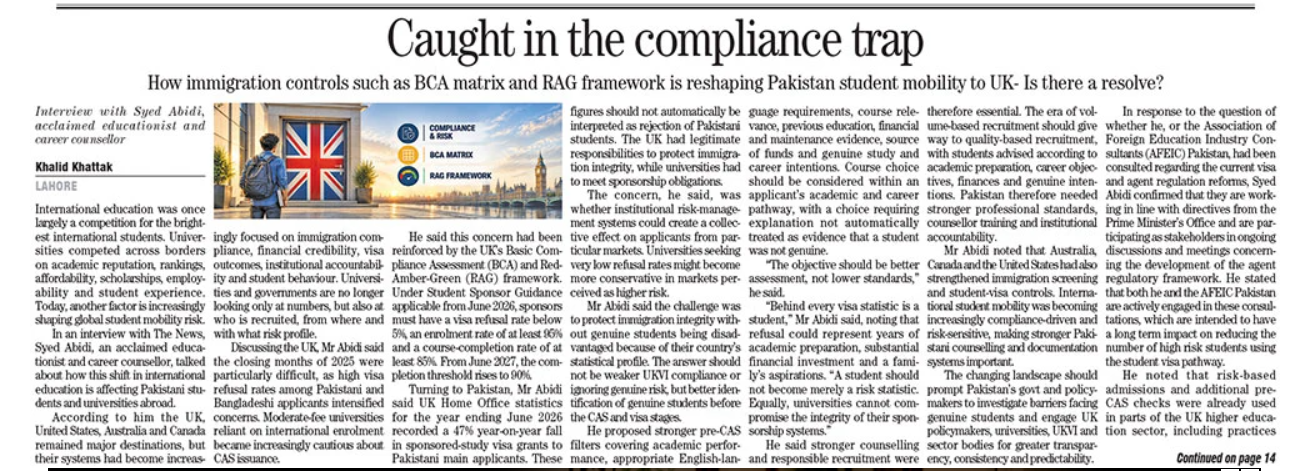
He said this concern had been reinforced by the UK’s Basic Compliance Assessment (BCA) and Red-Amber-Green (RAG) framework. Under Student Sponsor Guidance applicable from June 2026, sponsors must have a visa refusal rate below 5%, an enrolment rate of at least 95% and a course-completion rate of at least 85%. From June 2027, the completion threshold rises to 90%.
Turning to Pakistan, Mr Abidi said UK Home Office statistics for the year ending June 2026 recorded a 47% year-on-year fall in sponsored-study visa grants to Pakistani main applicants. These figures should not automatically be interpreted as rejection of Pakistani students. The UK had legitimate responsibilities to protect immigration integrity, while universities had to meet sponsorship obligations.
The concern, he said, was whether institutional risk-management systems could create a collective effect on applicants from particular markets. Universities seeking very low refusal rates might become more conservative in markets perceived as higher risk.
Mr Abidi said the challenge was to protect immigration integrity without genuine students being disadvantaged because of their country’s statistical profile. The answer should not be weaker UKVI compliance or ignoring genuine risk, but better identification of genuine students before the CAS and visa stages.
He proposed stronger pre-CAS filters covering academic performance, appropriate English-language requirements, course relevance, previous education, financial and maintenance evidence, source of funds and genuine study and career intentions. Course choice should be considered within an applicant’s academic and career pathway, with a choice requiring explanation not automatically treated as evidence that a student was not genuine.
“The objective should be better assessment, not lower standards,” he said.“Behind every visa statistic is a student,” Mr Abidi said, noting that refusal could represent years of academic preparation, substantial financial investment and a family’s aspirations. “A student should not become merely a risk statistic. Equally, universities cannot compromise the integrity of their sponsorship systems.”
He said stronger counselling and responsible recruitment were therefore essential. The era of volume-based recruitment should give way to quality-based recruitment, with students advised according to academic preparation, career objectives, finances and genuine intentions. Pakistan therefore needed stronger professional standards, counsellor training and institutional accountability.
Mr Abidi noted that Australia, Canada and the United States had also strengthened immigration screening and student-visa controls. International student mobility was becoming increasingly compliance-driven and risk-sensitive, making stronger Pakistani counselling and documentation systems important.
The changing landscape should prompt Pakistan’s govt and policymakers to investigate barriers facing genuine students and engage UK policymakers, universities, UKVI and sector bodies for greater transparency, consistency and predictability.
In response to the question of whether he, or the Association of Foreign Education Industry Consultants (AFEIC) Pakistan, had been consulted regarding the current visa and agent regulation reforms, Syed Abidi confirmed that they are working in line with directives from the Prime Minister’s Office and are participating as stakeholders in ongoing discussions and meetings concerning the development of the agent regulatory framework. He stated that both he and the AFEIC Pakistan are actively engaged in these consultations, which are intended to have a long term impact on reducing the number of high risk students using the student visa pathway.
He noted that risk-based admissions and additional pre-CAS checks were already used in parts of the UK higher education sector, including practices associated with more selective universities.
The same principle could be applied by non-Russell Group and moderate-fee universities attracting significant numbers of Pakistani students, using additional interviews, document and financial checks, academic progression verification and clearer study intentions rather than rejecting CAS applications because they originated from Pakistan.
In other words, Mr Abidi said, risk could be managed at applicant level rather than by treating an entire nationality as a risk category, with universities monitoring visa, enrolment, attendance and completion outcomes.
International education, he said, was more than a commercial activity. It was an investment in human capital, knowledge and international relationships.“The answer is neither completely open borders nor completely closed doors. It is intelligent, transparent and responsible mobility.”
Mr Abidi said UKVI, universities, compliance managers, policymakers, agents and student advisers needed to work towards a practical resolution. If present restrictions continued without a targeted, evidence-based mechanism, there could be collateral damage for Pakistani students and UK universities. Pakistan had historically contributed significant numbers of international students to the UK, generating substantial tuition-fee and wider economic revenue.“The challenge now is to develop better filters rather than wider barriers,” he said. “For Pakistan and the United Kingdom, the time to investigate, engage, reform and act is now.”